

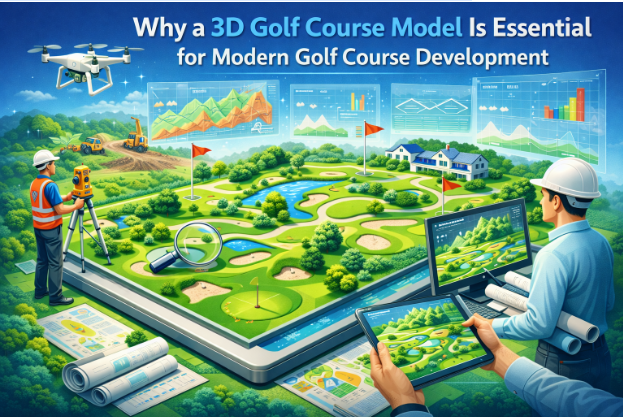

The development of modern golf courses is no longer based on intuition and conventional plans. The evolution of high-quality design, sustainability, and player experience pressure is pushing game developers towards using sophisticated digital tools to inform decision-making. Of these tools, the 3D golf course model has proven to be key in developing courses that are appealing to the eye and, at the same time, sound.
The planning, building, and maintenance of golf courses are changing due to their 3D golf course models, which bring a precise depiction of terrain and provide a simulated environment of the course.
Sound Terrain and Land Analysis
Each golf course is a product of the topography. The elevation, hills, and natural contours affect the gameplay, drainage, and maintenance. A three-dimensional model of a golf course records these characteristics of the terrain in three dimensions and enables a designer to analyze the land features to the utmost detail.
This step-by-step analysis assists in determining the opportunities and limitations of the design at the very beginning of the planning process and eliminates uncertainties and unwarranted changes in the construction phase that can be rather expensive.
Precision in Course Layout and Playability
A modern golf course has to be designed to ensure some level of challenge, fairness, and fun for the players across the board. A 3D model of golf courses allows the designers to plan the arrangements of holes, such as fairways and green positions, in a better way and view the sightlines and distances.
Such accuracy provides hazards with a strategic position, the feeling of natural angles when shooting, and intuitive course flow. Designers are able to polish the design virtually before starting any physical design, so the quality of the design is enhanced.
Improved Drainage and Water Management Planning
Good water management is also essential for the duration and playability of the course. Ineffective drainage may result in turf damage, soil erosion, and elevated maintenance expenses. A 3D model of a golf course will enable the designer to study the flow of water on the ground, the low-lying spots, and a better layout of the drainage systems.
Having slopes and elevation be seen at a more detailed level, teams are able to create draining solutions, which do not fight with nature, but with it, which makes course operations more sustainable.
Fewer Construction Risks and Design Errors
Traditional design techniques tend to expose problems after the construction has started, which makes the process slow and causes the budget to exceed. The risks of these are reduced by a 3D golf course model that enables the designer to detect early in the process any conflict between the terrain features, the elements of the course, and the infrastructure.
This proactive method will minimize rework, material waste, and changes that occur unexpectedly, which will keep the project on schedule and on budget.
Better Cooperation and Communication
Development of the golf course has several stakeholders, such as the architects, engineers, developers, and environmental consultants. The transfer of complex design information using technical drawings is in itself a source of miscommunication. A 3D model of a golf course is used as a common visual source of information that enhances teamwork.
When the most renowned 3D rendering firm develops them, such models possess the ability to unite both technical and visual clarity, so that every concerned party has grasped the design intent and can offer informed feedback.
Stronger Presentations for Approvals and Investment
The approvals and investment attraction in the new golf courses are very important steps in the development of the golf course. Presentations can be made more realistic by a 3D perspective on a golf course model of the course that is intended to be constructed. The design can be seen in the context by decision-makers, which makes them more confident and less uncertain.
Good graphics made by the best 3D rendering company can be used to convey the value of the project clearly and understandably, hence making the approval processes easier and more effective.
Sustainability and Environmental Planning
Sustainability is an emerging concern when developing a golf course. The 3D model of the golf course is useful in examining the environmental impact by showing how the course will interact with the existing ecosystems, water bodies, and vegetation cover.
Designers will be able to make effective modifications in order to save natural characteristics, increase the use of water, and lessen the impact on the environment without compromising the integrity of the design.
Maintenance and Upgrade Value over the Long-Term
The advantages of the 3D model of a golf course go beyond construction. The models are useful for long-term maintenance and renovations as well as upgrades. They allow course managers to learn about slopes, drainage systems, and the location of infrastructure, which will help maintain the executive and improve it in the future.
This is a long-term utility that makes 3D modeling worth investing in the present development of golf courses.
Conclusion
With the development of golf course projects becoming more elaborate and the expectations persisting, the 3D golf course model has emerged as a mandatory concept in contemporary development. It will allow making smarter decisions at each level by making the design more accurate, minimizing risks, improving collaboration, and contributing to sustainability.
Designed by the most creative 3D rendering company, a 3D model of a golf course makes the vision a reality – providing courses that play great and last long, and suit the needs of the players and developers of the modern era.